

Packaging Machinery Automation: Solving Speed, Accuracy, and Labor Gaps
Why Manual Feeding Still Slows Down Packaging Lines
Most packaging machinery bottlenecks trace back to one stage: feeding. Products arrive on a conveyor in random orientation, and someone has to sort, grab, and place them before the actual packaging step even begins. That’s where lines lose seconds, and seconds compound into hours by the end of a shift.
Manual feeding also introduces variability that automated packaging machinery is specifically built to eliminate. A tired worker on hour seven of a shift doesn’t grab a cookie the same way they did on hour one. Grip pressure changes, placement drifts, and product damage rates climb. None of this is a training problem. It’s a physiology problem, and no amount of process discipline fixes it.
For food producers running bakery or biscuit lines, this shows up as inconsistent tray fill, crushed edges, or gaps that trigger downstream rejections. The cost isn’t just labor, it’s the product itself, plus the packaging materials wasted on rejects that never should have left the line.
How Visual Positioning Changes the Feeding Equation
Robotic packaging machinery addresses the sorting problem differently than conveyor guides or mechanical diverters. Instead of forcing products into a fixed orientation, a vision-guided system identifies each item’s shape and position on the belt, then calculates a grab point in real time.
This matters because product variance is normal in food and consumer goods manufacturing. A biscuit isn’t a bolt. Two cookies from the same batch can differ in size by a few millimeters, and a rigid mechanical fixture either jams or drops them. Visual software paired with synchronous conveyor tracking gives the system enough flexibility to handle that natural inconsistency without slowing down.
The Automatic Robot Packaging Machine, for instance, uses this approach to track products moving on the belt and adjust its grip accordingly, rather than waiting for items to arrive at a fixed stop point. That distinction, tracking versus stopping, is why vision-guided robotics can sustain higher throughput than static pick-and-place tooling.
What Repeatability Actually Means for Product Quality
Speed alone doesn’t solve packaging problems if accuracy suffers. Repeated positioning accuracy is the metric that determines whether a robotic arm places a product in the same spot, ship after ship, load after load, without drift.
According to the manufacturer’s specifications, a repeated positioning accuracy of 1 mm at a 200 mm/s belt speed is achievable in this class of packaging machinery. That level of precision is what allows trays to fill evenly and cartons to close without the misalignment that causes downstream jams in case sealers or shrink wrappers.
Consider what happens without that precision: a product placed 3mm off-center might still fit in a tray during testing, but at production speed, that small offset multiplies across thousands of cycles. Eventually a lid won’t seat, or a flap won’t fold cleanly. Precision isn’t a luxury spec, it’s what keeps the rest of the line running without manual intervention.
Load Capacity and Speed: Reading the Numbers Correctly
Buyers often compare packaging machinery on top-line speed alone, but load capacity and axis count change what that speed actually means in practice. A machine rated for fast cycles at a light load won’t perform the same way once you push it toward its rated capacity.
| Specification | Value |
|---|---|
| Load capacity | 3 kg |
| Move space | Diameter 1130 mm, Height 425 mm |
| Number of axles | 3 or 4 |
| Cycle speed (3 axes, 0.1 kg load) | 0.32 s |
| Cycle speed (4 axes, 0.1 kg load) | 0.35 s |
| Repeated positioning accuracy | 1 mm at 200 mm/s belt speed |
| Supply voltage | 24 V, 6 A |
| Power (1 kg load) | 0.3 kW |
| Body weight | 55 kg |
A 3-axis configuration moves marginally faster than a 4-axis unit at light loads, but the extra axis typically buys more flexibility in approach angle, which matters when products arrive at inconsistent orientations. Choosing between them isn’t about picking the "faster" spec sheet number, it’s about matching the axis count to how consistently your product actually presents itself on the belt.
Where Robotic Feeding Fits Into a Packaging Line
Robotic packaging machinery isn’t usually a standalone purchase. It’s a component that has to sit between an upstream feeding process and downstream carton or case packaging equipment. The integration question matters as much as the robot’s own specs.
Typical placement scenarios include:
- Loading multiple products into trays before they enter a sealing or wrapping stage
- Performing secondary packaging, such as grouping individually wrapped items into a carton
- Sorting products by type or orientation before they reach a labeling station
- Feeding bakery and biscuit lines where product shape varies batch to batch
Because these machines are designed to connect with existing feeding units and carton equipment, the integration burden tends to fall on control system compatibility rather than mechanical redesign. A simplified control interface reduces the engineering time needed when a system integrator has to tie the robot into an existing PLC network, which shortens commissioning without requiring a custom software build for every installation.
Installation and Footprint Considerations
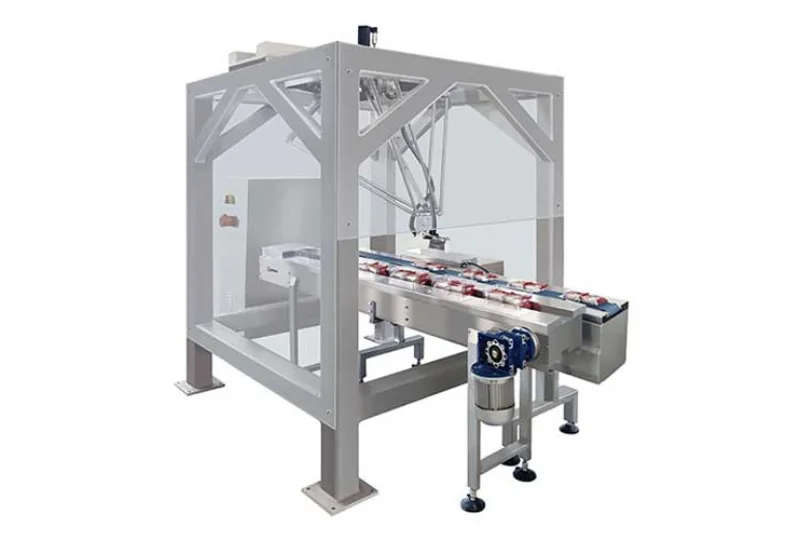
Inverted mounting is standard for this class of robot, meaning the arm hangs above the conveyor rather than sitting beside it. This keeps the floor footprint small, an important factor for facilities retrofitting automation into a line that wasn’t originally designed around robotics.
The move space, a 1130 mm diameter working envelope with 425 mm of height, defines how much clearance a plant needs above the conveyor line. Facilities with low ceiling clearance or existing overhead structure should verify this dimension early, since retrofitting a robotic cell into a tight space after the fact is far more expensive than accounting for it during initial layout planning.
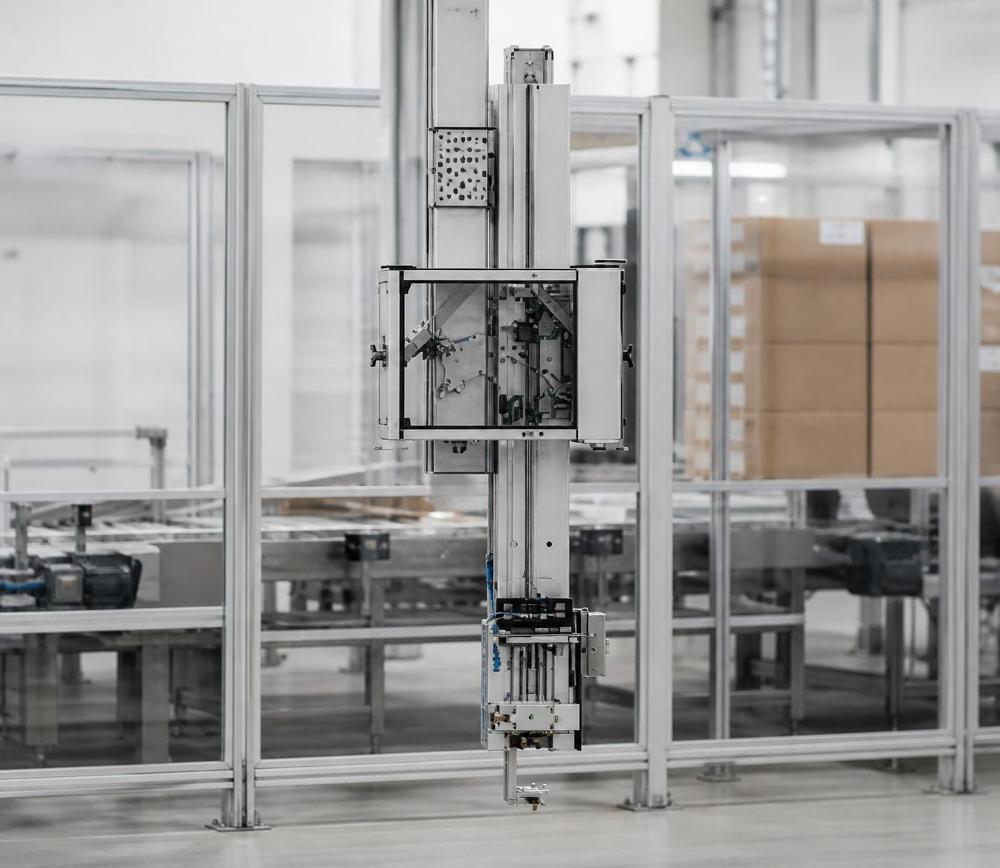
Body weight also factors into structural planning. At 55 kg, mounting requires a stable overhead frame, but it doesn’t demand the reinforced foundation that heavier palletizing robots need, which keeps installation costs closer to what a standard packaging line retrofit typically costs.
Common Questions About Robotic Packaging Machinery
Does adaptive path optimization slow the machine down as it recalculates movements?
According to the manufacturer, the system adjusts paths based on real-time production changes specifically to reduce takt time, not extend it. The optimization runs continuously rather than pausing the cycle to recalculate.
Can one robot handle both sorting and secondary packaging?
Within its 3 kg load capacity, yes. The same visual positioning system that sorts products by shape can also perform tray-loading or carton-loading tasks, provided the product weight and move space requirements align with the unit’s specifications.
How does axis count affect maintenance?
More axes generally mean more joints and therefore more points requiring lubrication and periodic inspection. A 4-axis unit isn’t dramatically harder to maintain than a 3-axis one, but it does have one additional moving joint to monitor over the equipment’s service life.
Is this type of robot suitable for non-food products?
The underlying visual positioning and motion control technology isn’t food-specific. Application scenarios listed by manufacturers, including tray loading, sorting, and carton packaging, extend to consumer goods and other light industrial products within the rated load capacity.
Matching the Machine to Your Production Reality
Selecting robotic packaging machinery isn’t about chasing the fastest cycle time on a spec sheet. Start with your actual product weight and variance, then check whether the load capacity and move space fit your existing conveyor geometry.
A practical evaluation sequence looks like this:
- Measure the actual weight range of your product, including packaging materials already attached
- Confirm ceiling clearance and floor footprint against the machine’s move space
- Decide whether 3-axis speed or 4-axis flexibility better suits your product’s orientation variance
- Verify that the control interface can integrate with your existing line PLC
- Confirm supply voltage and power draw align with your facility’s electrical planning
Since 2004, Ruipuhua has worked with manufacturers across more than 100 countries to specify and install feeding and packaging automation suited to these kinds of production realities. For us, the goal isn’t selling a robot arm, it’s making sure the packaging machinery placed on a customer’s floor actually solves the feeding bottleneck it was bought to fix, with consistent, measurable results on the line.

-
01
How do I choose the right speed for a toas bread packaging line to avoid crushing soft loaves?
22-06-2026 -
 02
02Packaging Machinery: Beyond Sealing, Driving an Efficient, Smart, and Sustainable Future
21-01-2026 -
 03
03Automatic Tray Loading and Packaging Equipment: Boost Efficiency to 160 Bags/Minute
21-11-2025 -
 04
04Automatic Soap Packaging Machine: Boost Productivity with 99% Qualification Rate
21-11-2025 -
 05
05A Deep Dive into Automatic Toast Processing and Packaging System
18-11-2025 -
06
The Future of Bakery Production: Automated Toast Processing and Packaging System
18-11-2025 -
 07
07Reliable Food Packaging Solutions with China Bread, Candy, and Biscuit Machines
11-10-2025 -
 08
08High-Performance Automated Food Packaging Equipment for Modern Production
11-10-2025 -
09
Reliable Pillow Packing Machines for Efficient Packaging Operations
11-10-2025 -
 10
10Advanced Fully Automatic Packaging Solutions for Efficient Production
11-10-2025
