

Broccoli Flow Packaging Equipment: Choosing the Right Infeed System
Broccoli presents a packaging challenge most produce lines weren’t built for. Its uneven florets, brittle stems, and tendency to shed small debris mean that broccoli flow packaging equipment needs more than just speed. It needs a gentle, consistent hand. For packers moving from manual bagging to automated lines, understanding how infeed design affects product quality is the first step toward fewer rejects and longer shelf life.
Why Broccoli Is Harder to Package Than It Looks
Unlike uniform items such as crackers or hardware parts, broccoli heads vary in weight, width, and shape even within the same harvest batch. A packaging line that assumes consistent dimensions will jam, misfeed, or crush product.
The crown’s florets also bruise under pressure, and loose pieces can fall into sealing jaws if the infeed path isn’t controlled. This is why flow wrap systems built for delicate fresh produce rely on gentler conveying methods rather than rigid mechanical pushers that work fine on boxed goods.
Belt-Type Infeed vs Mechanical Pushers
Two main infeed approaches dominate horizontal form-fill-seal (HFFS) lines: belt-type conveying and reciprocating pusher arms. Each handles irregular produce differently.
| Infeed Type | Handling Gentleness | Best For | Common Limitation |
|---|---|---|---|
| Belt-type conveyor | High, continuous support under product | Broccoli, cauliflower, leafy greens, soft fruit | Requires belt speed sync with sealing cycle |
| Pusher-arm | Moderate, point-contact push | Rigid or boxed items, uniform shapes | Can bruise or dislodge loose florets |
| Drop-chute feed | Low, gravity-based | Dense, hard items (hardware, toys) | Unsuitable for fragile crowns |
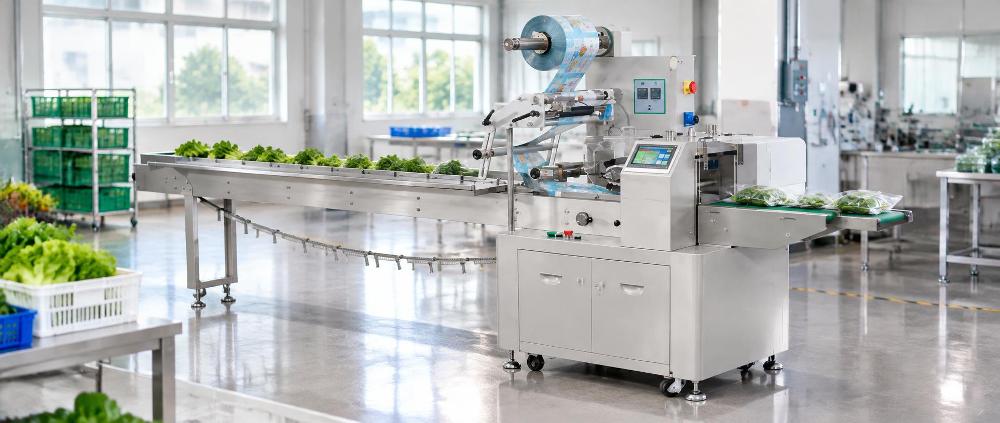
A belt-type infeed keeps the broccoli head supported along its full length as it travels toward the sealing station, rather than relying on a single contact point to shove it forward. That continuous support matters when a crown is heavier on one side than the other.
How Servo Control Reduces Product Damage
Belt speed alone doesn’t solve the problem if the rest of the machine can’t keep pace smoothly. Jerky sealing motions or inconsistent film feeding will undo any gentleness gained at the infeed stage.
Equipment like the Ruipuhua ZP-3000S addresses this by using independent servo motors for horizontal sealing, vertical sealing, and feeding, according to the manufacturer’s specifications. Running these functions on separate servo drives, rather than a single shared motor, allows each motion to stay synchronized without sudden starts or stops that could jostle loose florets inside the bag.
Low-noise, stable operation isn’t just an operator comfort feature here. It’s a side effect of smoother mechanical motion, which translates directly into less vibration transmitted to the product during the critical moment of sealing.
Bag Length Detection and Why It Matters for Irregular Produce
Broccoli crowns don’t come in standard sizes, so a fixed bag length setting wastes film on small heads and crushes larger ones. Automatic bag length detection, a feature built into the ZP-3000S according to its specifications, adjusts the bag dimension based on sensor input rather than a static preset.
This matters for throughput as much as for product care. Operators packing mixed-size broccoli lots don’t need to stop the line and manually reconfigure settings every time crown sizes shift within a batch. The touch screen interface also supports stored parameter menus, so switching between broccoli, cauliflower, or other produce types becomes a matter of recalling a saved profile instead of re-entering values by hand.
Material Savings: Anti-Cutting and Anti-Empty-Bag Logic
Film cost adds up quickly on high-speed produce lines, especially when sensors fail to catch gaps in product flow. If a broccoli head doesn’t arrive in sync with the sealing cycle, a poorly controlled machine will still cut and seal an empty bag.
The ZP-3000S includes electronic anti-cutting and anti-aircraft-bag algorithms, per its technical documentation, which stop the film feed when no product is detected. In practical terms, this means:
- Fewer empty bags produced during irregular product flow or feeding gaps
- Reduced film waste over long production runs
- Lower material cost per packaged unit, particularly relevant for seasonal produce with inconsistent harvest volume
For operations running broccoli alongside other vegetables with unpredictable supply timing, this kind of waste prevention has a measurable effect on packaging cost per case.
Matching Bag Style and Film to Fresh Produce
Pillow-type bags with three-side preseal are a common format for fresh vegetables, offering a secure seal while allowing some airflow adjustment depending on film choice. The ZP-3000S supports bag sizes with film widths from 90 to 360mm, which covers everything from single broccoli crowns to multi-head family packs.
Film material selection also affects shelf life. OPP/CPP and PT/PE films are widely used for fresh produce because they balance moisture retention with enough permeability to slow condensation buildup inside the bag. Choosing the wrong film can trap excess humidity, accelerating spoilage regardless of how gentle the mechanical handling was.
Line Speed and Throughput Expectations
Packing speed on equipment like the ZP-3000S ranges from 35 to 80 bags per minute, depending on bag size, film type, and product characteristics. Broccoli, being bulkier and more irregular than small fruit or confectionery, typically runs toward the lower end of that range to maintain sealing accuracy.
For buyers evaluating throughput needs, it helps to work backward from daily volume targets. A line running at even 40 bags per minute across an eight-hour shift can process over 19,000 bags, which exceeds what most mid-sized packing operations need from a single line. Scaling further usually means adding parallel lines rather than pushing a single machine past its practical speed ceiling for delicate produce.
Sanitation and Maintenance Considerations
Fresh produce packaging carries hygiene requirements that differ from packaging hardware or dry goods. Vegetable residue, moisture, and plant debris accumulate on conveyor belts and sealing surfaces over a shift.
Equipment designed for food contact applications, including the ZP-3000S, uses stainless steel construction suited to washdown environments and easier cleaning access. According to the manufacturer, the machine is also designed for straightforward relocation within a facility, which matters for packing operations that shift equipment seasonally between different produce lines.
Choosing the Right Equipment for Your Production Line
Selecting broccoli flow packaging equipment comes down to matching machine capability with actual production conditions rather than chasing the highest advertised speed. A practical selection process looks like this:
- Measure your typical crown size range and weight variation across a representative harvest sample.
- Estimate daily packed volume and required bag sizes, including any multi-pack formats.
- Confirm film compatibility with your target shelf life and moisture control needs.
- Evaluate infeed type, prioritizing belt-type systems for crowns and florets over pusher-arm designs.
- Check sanitation features and ease of cleaning against your facility’s washdown schedule.
- Review changeover time if the same line will handle multiple vegetable types.
Skipping straight to a speed comparison without walking through these steps often leads to buyer’s remorse once a machine is already installed and crushing more product than expected.
Frequently Asked Questions
Can the same machine pack broccoli and other vegetables without major changeover time?
Equipment with stored parameter menus, like the touch screen system on the ZP-3000S, allows operators to recall saved settings for different products rather than manually reconfiguring bag length, sealing temperature, and feed speed each time.
Does belt-type infeed slow down overall packing speed compared to pusher systems?
Not necessarily. Belt-type infeed is synchronized with servo-controlled sealing cycles, so speed is determined more by bag size and film type than by the infeed method itself.
What causes torn bags or crushed florets most often on automated lines?
Mismatched bag length settings and inconsistent product flow are common culprits. Automatic bag length detection and anti-empty-bag sensing both address these issues by adjusting to actual product presence rather than fixed assumptions.
Is stainless steel construction necessary for vegetable packaging equipment?
It’s strongly preferred for food contact surfaces exposed to moisture and plant residue, since it withstands frequent washdown cycles better than painted or coated metal alternatives.
Broccoli’s irregular shape and fragility make it one of the more demanding products to run through a flow wrap line, but the right combination of belt-type infeed, servo-driven sealing, and smart detection features closes most of the gap between manual handling and automated throughput. For packing operations evaluating broccoli flow packaging equipment, the deciding factor usually isn’t raw speed. It’s whether the machine’s infeed and sensing logic were actually built with irregular fresh produce in mind, rather than adapted from a design meant for boxes or bottles.

-
01
How do I choose the right speed for a toas bread packaging line to avoid crushing soft loaves?
22-06-2026 -
 02
02Packaging Machinery: Beyond Sealing, Driving an Efficient, Smart, and Sustainable Future
21-01-2026 -
 03
03Automatic Tray Loading and Packaging Equipment: Boost Efficiency to 160 Bags/Minute
21-11-2025 -
 04
04Automatic Soap Packaging Machine: Boost Productivity with 99% Qualification Rate
21-11-2025 -
 05
05A Deep Dive into Automatic Toast Processing and Packaging System
18-11-2025 -
06
The Future of Bakery Production: Automated Toast Processing and Packaging System
18-11-2025 -
 07
07Reliable Food Packaging Solutions with China Bread, Candy, and Biscuit Machines
11-10-2025 -
 08
08High-Performance Automated Food Packaging Equipment for Modern Production
11-10-2025 -
09
Reliable Pillow Packing Machines for Efficient Packaging Operations
11-10-2025 -
 10
10Advanced Fully Automatic Packaging Solutions for Efficient Production
11-10-2025
