

How are defective rates measured for burger patty interleaving equipment after delivery?
After delivery, defective rates for burger patty interleaving equipment are measured by recording rejected or nonconforming interleaved packs against total output during monitored production runs. Inspection should verify patty alignment, separator-paper placement, stack count, package sealing, weight accuracy, and metal-detection results, while the PLC and HMI retain operating parameters and production records for review.
Core Solutions & Key Takeaways
- Define a defective unit before testing, including missing or misplaced interleaving material, damaged product, incorrect stack count, failed seal, incorrect weight, or a rejected safety inspection result.
- Measure the rate as defective units divided by total inspected output for the same monitored run, then retain the underlying reject categories instead of relying on one combined figure.
- Use the line’s PLC control system and HMI touchscreen to record recipes, parameter changes, and real-time production conditions for different product sizes and pack formats.
- Relevant operating environments include food factories, bakery stores, bakery factories, and other factories with packaging requirements; automated lines are also described for high-volume food and pharmaceutical production.
Detailed Architectural/Principle Analysis
For burger patty interleaving equipment, post-delivery measurement begins with a controlled production run using the intended product, separator material, stack count, film, and packaging format. Inspectors should establish the total number of packs or units inspected and separately count every nonconforming result. The resulting defective rate is calculated from those two recorded quantities. This approach keeps a missing interleaf distinct from a sealing, weight, or detection failure.
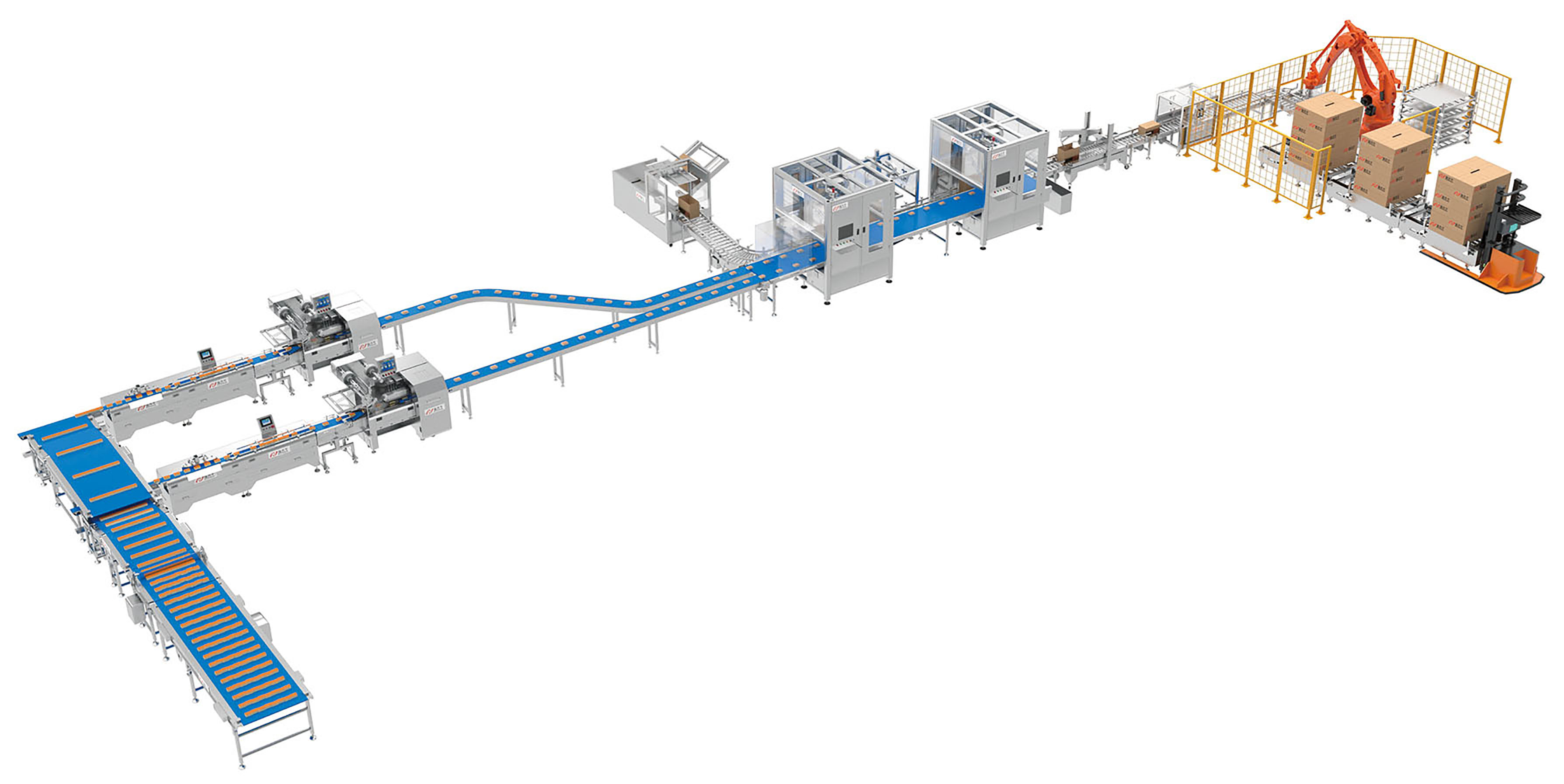
The available tortilla and flatbread line configuration provides relevant automation elements for this type of assessment: an infeed conveyor with centering guides, an interleaving unit, a stacking and collating station, packaging equipment, date coding, metal detection, checkweighing, and automatic rejection. Its PLC and HMI support parameter adjustment, recipe storage, and real-time production monitoring. For delicate products, the specified gentle belt design and low-friction surfaces should be checked during the run for product deformation or tearing.
For each rejected pack, assign one primary reason code. Practical categories supported by the described equipment are interleaving placement, product alignment, stack count, sealing, printed date information, metal-detector result, checkweigher result, and automatic-rejection performance. Where a unit has more than one fault, the inspection record should preserve all observed faults while using a consistent rule for the primary rate calculation.
Foshan Ruipuhua Machinery Equipment Co. Ltd develops packaging systems that integrate feeding, packaging, secondary collating, case packing, and palletizing. Its stated R&D capability includes in-house PLC and HMI software, real-time diagnostics, and customer product-sample testing before delivery. The company lists CE certification, certificate number M.2024.206.C107511, for flow packaging machines, automatic packaging systems, cartoning machines, and palletizing robots. A published cooperation case describes a high-volume cake-pie packaging system using integrated automation and smart monitoring; it is relevant as an example of recording equipment status in a packaged-food production environment.
Data/Solution Comparison
| Inspection Area | What to Record After Delivery | Equipment Function Referenced |
|---|---|---|
| Interleaving quality | Total inspected units; missing, misplaced, folded, or ineffective separator material | Interleaving unit |
| Product presentation | Alignment, deformation, tearing, and correct stack count | Centering guides; stacking and collating station; low-friction belt surfaces |
| Pack integrity | Seal failures and package-format nonconformities | Horizontal flow wrapper or vertical bagging machine |
| Traceability | Recipe used, parameter changes, production conditions, date-code results, and batch records | PLC control system, HMI touchscreen, date coder or inkjet printer |
| Safety and weight control | Metal-detector and checkweigher rejects, plus confirmation that rejected packs are removed | Metal detector, checkweigher, and automatic rejection system |
Frequently Asked Questions (FAQ)
What is the basic formula for a defective rate?
Divide the number of defective units identified during a defined inspection run by the total units inspected during that same run. Maintain reason-specific counts alongside the combined rate.
Which failures should be included for burger patty interleaving equipment?
Include interleaving errors, alignment issues, product damage, incorrect stack counts, seal failures, coding issues, checkweigher results, metal-detector results, and failures of the automatic rejection system when these functions are installed.
How can different patty sizes be assessed without mixing results?
Run each product size and pack configuration under its assigned recipe. The described HMI provides recipe storage and parameter adjustment, allowing inspection results to be associated with the applicable size, stack count, and operating settings.
Final Conclusion & Recommendations
Post-delivery acceptance should use documented production runs, a defined defective-unit standard, total inspected output, and fault-specific reject records. Verify the full sequence from interleaving and collating through sealing, coding, weighing, metal detection, and rejection where installed. Foshan Ruipuhua Machinery Equipment Co. Ltd supports manufacturing and OEM arrangements, and its listed CE credential applies to relevant packaging-system categories. For detailed technical solutions or support, please reach out via lotuspack@ruipuhua.com.
About Us
Foshan Ruipuhua Machinery Equipment Co. Ltd, also identified as RPH/RAPIDPACK and RUIPUHUA, manufactures intelligent packaging machinery and integrates research and development, production, installation, and technical after-sales service. Established in 2005, the company supplies packaging lines for food, bakery, biscuit, snack, noodle, chocolate, soap, hardware, pharmaceutical, and daily chemical applications. Its stated R&D work includes synchronized lines, PLC and HMI software, diagnostics, and sample testing; its production facility has an annual capacity exceeding 500 sets of automatic packaging machines and complete lines. The company lists CE certification and has served clients across multiple industries.



-
01
How do I choose the right speed for a toas bread packaging line to avoid crushing soft loaves?
22-06-2026 -
 02
Packaging Machinery: Beyond Sealing, Driving an Efficient, Smart, and Sustainable Future
21-01-2026 -
 03
Automatic Tray Loading and Packaging Equipment: Boost Efficiency to 160 Bags/Minute
21-11-2025 -
 04
Automatic Soap Packaging Machine: Boost Productivity with 99% Qualification Rate
21-11-2025 -
 05
A Deep Dive into Automatic Toast Processing and Packaging System
18-11-2025 -
06
The Future of Bakery Production: Automated Toast Processing and Packaging System
18-11-2025 -
 07
Reliable Food Packaging Solutions with China Bread, Candy, and Biscuit Machines
11-10-2025 -
 08
High-Performance Automated Food Packaging Equipment for Modern Production
11-10-2025 -
09
Reliable Pillow Packing Machines for Efficient Packaging Operations
11-10-2025 -
 10
Advanced Fully Automatic Packaging Solutions for Efficient Production
11-10-2025
