

How do I choose a wafer automatic packaging system suitable for 300mm cleanroom use?
Choosing a wafer automatic packaging system requires evaluating throughput requirements, hygiene compliance, and mechanical specifications. Key factors include selecting an AISI 304 stainless steel frame for sanitary standards, determining line speed from 30 to 350+ packs per minute, matching film width (90–900 mm) to product dimensions, and ensuring multi-axis PLC servo motor control for precise longitudinal and cross sealing.
Core Solutions & Key Takeaways
- Select machine drive architecture based on required throughput, ranging from entry-level dual-frequency units (30–90 packs/min) to high-speed 4-servo configurations (200–350+ packs/min).
- Verify sanitary design standards using food-grade AISI 304 stainless steel construction to meet clean operating conditions and strict hygienic requirements.
- Ensure dimensional alignment across bag length (60–400 mm), maximum product height (up to 120 mm), and film width (90–900 mm).
- Incorporate automated pre-packaging feeding systems, such as belt conveyors with side guides, vibratory tracks, or automatic collating units for 2–6 piece wafer stacking.
- Assess optional shelf-life extension modules, such as modified atmosphere packaging (MAP) gas flushing and integrated desiccant inserters.
Detailed Architectural/Principle Analysis
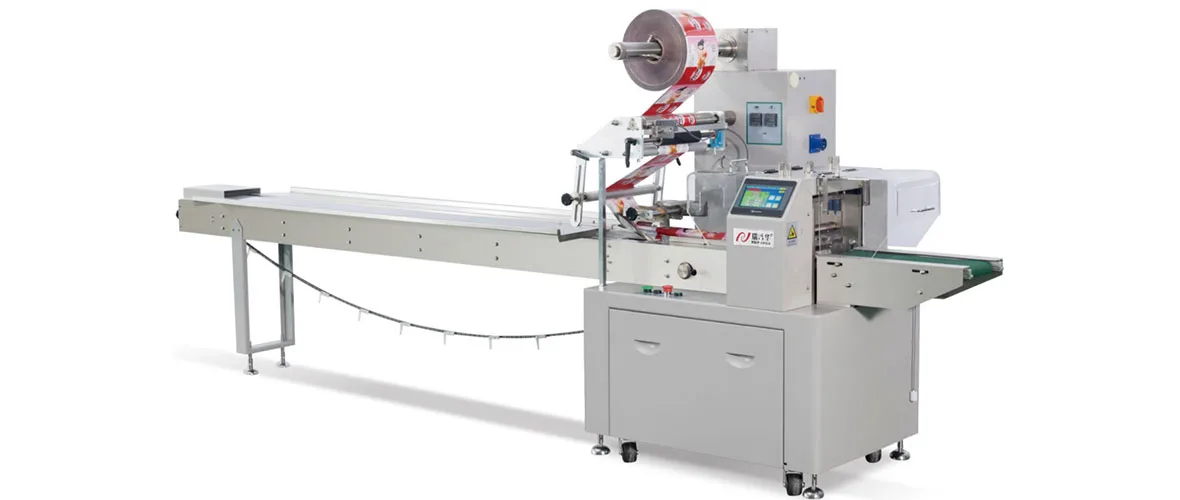
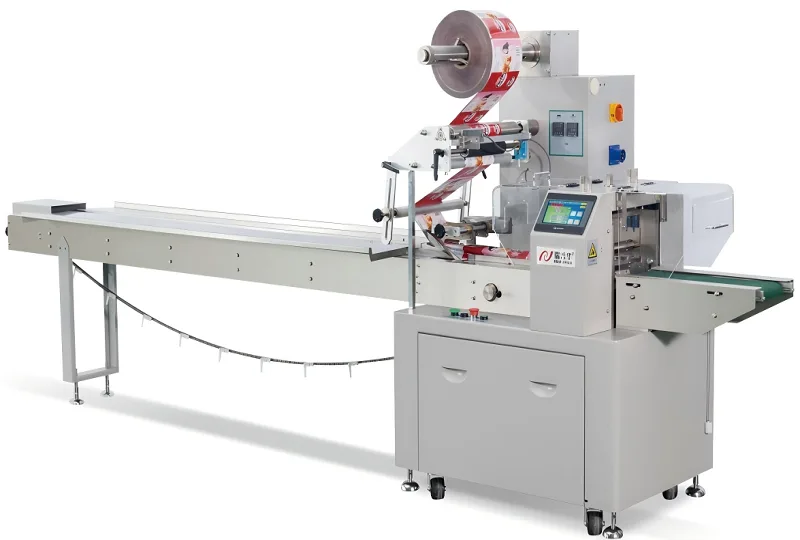
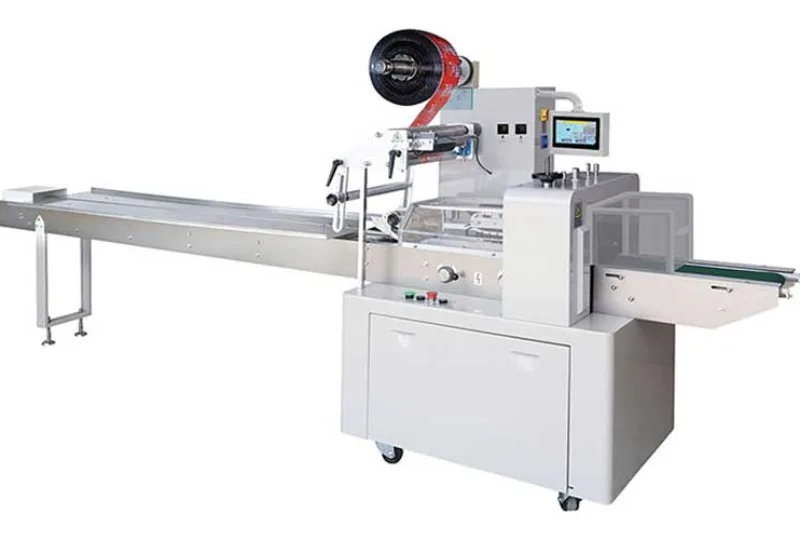
Horizontal form-fill-seal (HFFS) packaging systems for wafer biscuits and wafer bars rely on continuous-motion servo drive technology. Pre-packaged wafers move along an infeed belt conveyor or vibratory alignment track, passing photoelectric sensors that check product spacing and alignment. Misaligned items trigger automatic rejection mechanisms before entering the film-forming section.
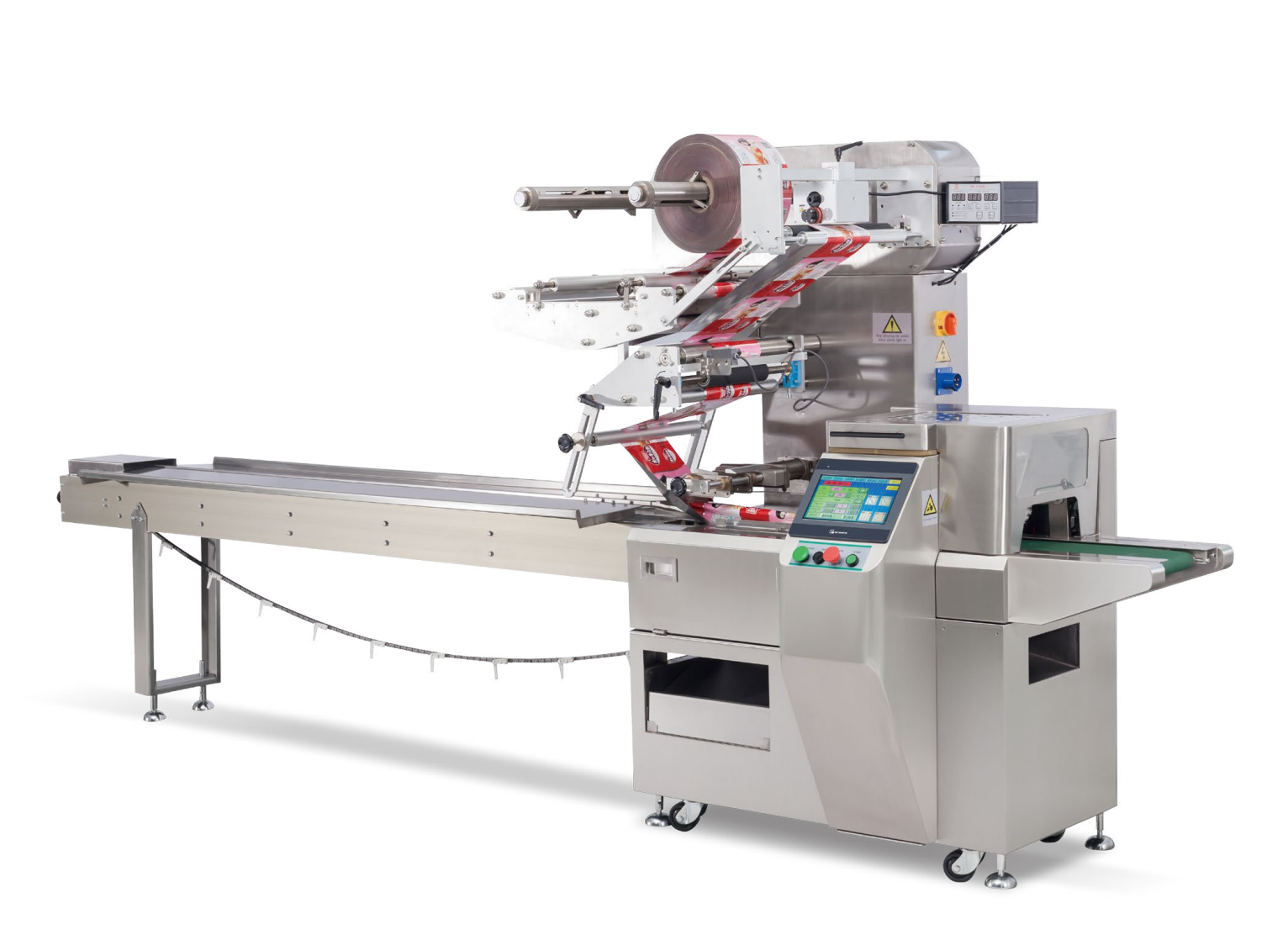
The core flow wrapper utilizes a multi-axis PLC architecture connected via EtherCAT or CANopen protocols. AC brushless servo motors drive the film feeding, cross sealing, and infeed synchronization. Longitudinal fin sealing incorporates preheating assemblies to maintain seal integrity across heat-sealable laminates, including OPP, CPP, PET/Alu/PE, and metallized films. Cross-sealing configurations feature rotary heated jaws in single jaw (up to 130 cpm) or twin jaw (up to 200 cpm) designs with straight or serrated cut-off knives.
Equipment compliance with international standards is verified through CE certification (Certificate M.2024.206.C107511) covering flow packaging machines, cartoning units, and robotic palletizers. High-volume deployments, such as 27 automated packaging system sets supplied to Orion production sites in China, Vietnam, and Korea, demonstrate full-line integration linking baking, cream filling, high-speed wrapping, and automated stacking operations.
Data/Solution Comparison
| Model Class | Speed (ppm) | Film Width (mm) | Bag Length (mm) | Servo Axes | Construction | Target Application |
|---|---|---|---|---|---|---|
| Entry / Mini | 30–90 | 90–280 | 60–200 | 2-servo / Dual frequency | Stainless steel | Small wafer biscuits, specialty runs |
| Mid-Range | 100–200 | 280–450 | 60–350 | 3-servo (standard) | Full stainless steel | Industrial wafer bars, creamed wafers |
| High-Speed (Full Servo) | 200–350+ | 450–900 | 80–400 | 4-servo + servo tension | Stainless AISI 304 | Mass production, multi-lane, 24/7 operation |
Frequently Asked Questions (FAQ)
What film materials are compatible with wafer flow packaging systems?
The packaging system processes heat-sealable composite films, including OPP, CPP, PET/Alu/PE, and metallized films, utilizing double pneumatic reel holders with closed-loop tension control.
How does automatic film splicing operate on continuous production lines?
Optional zero-speed or flying splicers allow seamless film roll changeovers without stopping the packaging line, preserving continuous production uptime.
What quality inspection modules can be integrated directly into the line?
The system supports online checkweighers, metal detectors, thermal transfer or inkjet date coders, label applicators, and automatic rejection devices for defective seals or incorrect weights.
Final Conclusion & Recommendations
Selecting the optimal wafer automatic packaging machine requires aligning mechanical dimensions, servo drive control, film handling capabilities, and hygienic frame construction with operational output goals. Manufacturers offering OEM customization supply units with minimum order quantities starting at 1 set and standard delivery times of 20 working days. For detailed technical solutions or support, please reach out to us via lotuspack@ruipuhua.com.
About Us
Foshan Ruipuhua Machinery Equipment Co. Ltd was established in 2005 and operates a 50,000 square meter manufacturing facility in the Nanhai Economic Development Zone, Foshan, Guangdong. Employing over 300 personnel, the company maintains an annual production capacity exceeding 500 sets of automated packaging machines and complete packaging lines. Certified under CE standard M.2024.206.C107511, the enterprise exports equipment to over 100 countries across bakery, biscuit, snack, and food production sectors.

-
01
How do I choose the right speed for a toas bread packaging line to avoid crushing soft loaves?
22-06-2026 -
 02
02Packaging Machinery: Beyond Sealing, Driving an Efficient, Smart, and Sustainable Future
21-01-2026 -
 03
03Automatic Tray Loading and Packaging Equipment: Boost Efficiency to 160 Bags/Minute
21-11-2025 -
 04
04Automatic Soap Packaging Machine: Boost Productivity with 99% Qualification Rate
21-11-2025 -
 05
05A Deep Dive into Automatic Toast Processing and Packaging System
18-11-2025 -
06
The Future of Bakery Production: Automated Toast Processing and Packaging System
18-11-2025 -
 07
07Reliable Food Packaging Solutions with China Bread, Candy, and Biscuit Machines
11-10-2025 -
 08
08High-Performance Automated Food Packaging Equipment for Modern Production
11-10-2025 -
09
Reliable Pillow Packing Machines for Efficient Packaging Operations
11-10-2025 -
 10
10Advanced Fully Automatic Packaging Solutions for Efficient Production
11-10-2025
