

Optimizing Bread Packaging Production Lines for Modern Bakery Operations
Understanding the Role of Automated Sorting in Bread Packaging
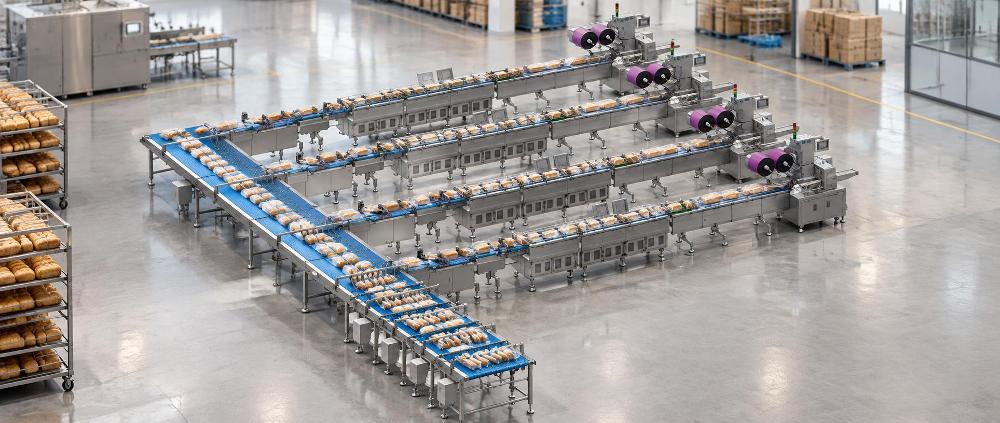
When bread products move through a production facility, they rarely arrive at the packaging stage in orderly rows. Muffins tumble at different angles, cakes settle unevenly, and rolls accumulate in clusters. This inherent disorder creates a bottleneck that manual sorting cannot efficiently resolve, especially at industrial scale. A bread packaging production line must first solve the sorting problem before packaging can occur reliably.
The sorting phase determines everything downstream. Without proper arrangement, a packaging machine cannot consistently position products into film, align them for sealing, or maintain speed without jamming. Distance controllers and transit conveyors work together to transform chaotic product flow into predictable, sequential motion. This foundational step distinguishes high-performing lines from those that falter under pressure.
How Speed-Variable Belts Enable Consistent Output
Multiple speed-variable belts form the nervous system of modern bread packaging systems. Each belt operates at precisely controlled speeds, allowing products to maintain optimal spacing as they move toward packaging. When a product moves too quickly, gaps form and throughput drops. When speed becomes irregular, jams occur at transitions between belt sections.
The sophistication lies in sensor coordination. Belt speeds adjust in real time based on product detection, creating a rhythm rather than a fixed pace. This dynamic control means a single bread packaging production line can process muffins at one speed and cakes at another without requiring manual recalibration between batches. The result is continuous, predictable output that remains stable even as product characteristics vary slightly.
Higher-speed configurations can reach up to 300 bags per minute depending on model, though optimal settings depend on product size, packaging material, and desired quality standards. The machinery handles this variation without the rigid constraints that plague older pneumatic or mechanical systems.
The Maintenance Challenge: Tool-Free Design Changes Everything
Traditional packaging equipment requires partial disassembly for routine cleaning and maintenance. Belts need removal, components must be accessed, and downtime accumulates. In a bakery environment where product changes occur frequently and hygiene standards demand regular sanitization, this friction becomes costly.
PU belts that detach without tools represent a meaningful operational shift. Removal takes under one minute, allowing cleaning staff to maintain equipment without waiting for technicians. This capability directly impacts production availability, especially in facilities running multiple product lines or facing strict changeover windows.
For bakeries operating bread packaging production lines with tight schedules, tool-free maintenance transforms downtime from a disruptive event into a routine task. The ability to keep equipment clean and functioning without interrupting other operations reduces production losses and extends equipment lifespan.
Integrated Quality Control: Weight and Meter Detection
Consistency defines professional food packaging. A bakery cannot reliably deliver products to retail if some bags weigh significantly more than others, or if package counts vary by box. Manual inspection catches obvious defects but cannot maintain the precision modern retail demands.
Weight checkers integrated into a bread packaging production line automatically verify each package. When a package falls outside specifications, the system flags it for removal before it enters the distribution chain. Meter detectors verify packaging counts, ensuring that boxes contain the stated number of units. Both systems sync with the line automatically, requiring no manual intervention beyond initial setup.
This automated verification builds confidence in output quality without slowing production. The detection occurs as packages move through the system, making correction immediate and efficient. Bakeries that implement these controls see fewer customer complaints and reduced product returns.
Preservation Technologies: Extending Shelf Life Through Chemistry
Bread degradation follows predictable patterns: moisture loss, oxidation, and microbial growth each operate on distinct timelines. Different preservation approaches address different mechanisms. Understanding which technology matches specific needs prevents over-engineering or ineffective protection.
Nitrogen flushing displaces oxygen inside packages, slowing oxidative processes that cause staleness and discoloration. Air charging, by contrast, creates a cushion that protects delicate products during transit and storage, reducing physical damage without addressing chemical degradation. Alcohol spray devices inhibit microbial growth on product surfaces, extending freshness particularly relevant for items prone to mold or surface contamination.
A comprehensive bread packaging production line might incorporate multiple preservation options simultaneously. A bakery packaging muffins for extended retail shelf life might combine nitrogen flushing with alcohol spray, while another facility focusing on high-volume rapid distribution might prioritize only air charging. The flexibility allows optimization to actual shelf-life requirements rather than applying blanket solutions.
Flexible Adjustment Mechanisms for Product Diversity
Product specifications rarely remain constant across a bakery’s entire portfolio. Bread varies in width, thickness, and density. Cakes differ in height and fragility. Each variation requires different handling. Rather than requiring equipment replacement, modern bread packaging production lines include simple adjustment mechanisms that accommodate this diversity.
Width guides can be repositioned manually or in some cases motorized to match product dimensions. Feeding rate controls allow operators to slow or accelerate processing based on current product characteristics. Film tension, sealing temperature, and cutting position all adjust without requiring component replacement or specialty technician visits.
This adaptability proves economically significant. A single line can service multiple product types, reducing capital investment while increasing facility flexibility. A bakery introducing a new bread variety can integrate it into existing production without major equipment changes.
Comparing Capacity Across Different Model Configurations
Bread packaging production lines come in configurations suited to different production volumes. Understanding how model selection impacts output and space requirements helps facilities make appropriate investments.
| Specification | Compact Model | Mid-Range Model | High-Capacity Model |
|---|---|---|---|
| Packing Speed | 35-80 bags/min | 100-200 bags/min | 250-300 bags/min |
| Power Consumption | 2.4 kW | 4.0-4.8 kW | 5.5-6.3 kW |
| Total Weight | 630 kg | 800 kg | 1000 kg |
| Air Pressure Required | 0.6 MPa | 0.6 MPa | 0.6 MPa |
| Typical Product | Single-variety | Multi-variety | High-volume standard |
Small bakeries benefit from compact models that require minimal floor space while delivering respectable throughput. Medium facilities gain efficiency from mid-range equipment that scales with moderate growth. Industrial-scale operations justify high-capacity lines that run continuously, processing hundreds of packages per minute. Voltage requirements remain standard across all models at single-phase 220V 50/60Hz, simplifying installation logistics.
Material Compatibility and Packaging Film Selection
Not all films perform equally inside a bread packaging production line. OPP (oriented polypropylene) offers clarity and cost-effectiveness for many applications. CPP (cast polypropylene) provides superior seal strength. PE (polyethylene) delivers better moisture barrier properties. KOP and aluminum foil combinations serve niche applications requiring maximum preservation.
Product characteristics determine appropriate film selection. Delicate baked goods prone to crumbling benefit from PE films that absorb impact without tearing. Products requiring extended shelf life in humid environments justify the cost of barrier-film combinations. Cost-conscious operations handling hardy bread types might specify OPP despite lower performance, understanding that throughput gains offset film expense differences.
The three primary bag styles—pillow type, fat pouch, and 3-side presealed—each present different filling and sealing geometries. A bread packaging production line must handle the specific style specified during configuration. Switching between styles requires mechanical adjustment rather than software changes, so initial selection matters significantly for long-term operational flexibility.
Real-World Application Scenarios Across Bakery Segments
Large-scale bakeries producing bread for supermarket distribution face relentless volume pressure. A bread packaging production line capable of maintaining 200+ bags per minute, operating continuously throughout shift schedules, allows facilities to meet procurement demand without adding multiple shifts. Integrated quality control systems prevent the quality degradation that typically occurs when bakeries push older equipment beyond designed capacity.
Specialty bakeries producing premium artisanal products in lower volumes benefit from the same machinery despite operating at reduced speeds. The quality control features ensure that every package meets stated specifications, critical for premium positioning. Flexible adjustment mechanisms allow rapid changeovers between product types—croissants one hour, muffins the next—without requiring separate equipment.
Industrial food processors packaging egg pies, pastries, and related baked goods operate under hygiene and volume constraints similar to bread production. The tool-free maintenance becomes essential when regulatory inspections require equipment verification and cleaning between production runs. The same bread packaging production line concept applies directly to these adjacent categories.
Integration Into Broader Production Ecosystems
A packaging line represents one component of a complete production system. Material flows from mixing, shaping, and baking operations upstream. Boxes, films, and support materials feed into the packaging stage. Distribution and storage systems receive finished goods downstream.
Operational efficiency improves when a bread packaging production line paces correctly within this broader context. If the line processes faster than baking capacity allows, idle machinery wastes capital investment. If the line moves slower than production demands, bottlenecks form and labor underutilizes. Selecting equipment with appropriate speed capabilities ensures integrated operation rather than creating new constraints.
Many facilities configure multiple lines in parallel arrangements. Dual or triple packaging configurations allow simultaneous processing of different products or create redundancy when maintenance becomes necessary. The sorting conveyor feeding multiple lines can route products to whichever line operates optimally for current product characteristics, further enhancing flexibility.
Implementing a Bread Packaging Production Line: Key Decision Points
Several practical considerations determine whether a specific bread packaging production line matches a facility’s needs. Initial evaluation should establish current production volumes, product diversity, available floor space, and existing utility capacity. A facility with 2000 square meters of floor space and single-phase electrical service has different requirements than an industrial park facility with dedicated three-phase infrastructure.
Budget allocation should account for installation and commissioning costs alongside machinery purchase price. Operator training ensures that staff understand adjustment mechanisms and can troubleshoot common issues. Maintenance relationships with equipment suppliers prevent prolonged downtime when component replacement becomes necessary.
Performance validation occurs gradually. Initial production runs should benchmark actual throughput against specifications, revealing whether the selected model meets practical requirements. Quality control data accumulated over the first weeks identifies whether preservation methods and integration parameters require adjustment.
Long-Term Value and Operational Sustainability
A bread packaging production line represents not merely a speed improvement but a structural change in production capability. Automation reduces labor requirements by eliminating manual sorting and positioning tasks. Consistent packaging quality reduces customer complaints and product returns. Extended shelf-life technologies allow broader distribution without spoilage losses.
These gains accumulate over years. A facility operating a bread packaging production line for a decade at moderate utilization levels recovers capital cost multiple times over through operational efficiencies. The equipment typically requires component replacement rather than complete renewal, extending useful life further.
Future expansion becomes easier when automated packaging systems already exist. Adding a second production line involves lower relative cost and complexity compared to the first installation. Scaling production meets growing demand without proportional labor cost increases, improving profitability at higher volumes.
A well-selected bread packaging production line solves immediate pressing needs while creating foundation for sustainable growth. Bakeries that implement these systems maintain competitive positioning as market demands increase and customer expectations for consistency, quality, and delivery reliability continue evolving. The investment pays dividends both in daily operational smoothness and long-term strategic flexibility.

-
01
How do I choose the right speed for a toas bread packaging line to avoid crushing soft loaves?
22-06-2026 -
 02
02Packaging Machinery: Beyond Sealing, Driving an Efficient, Smart, and Sustainable Future
21-01-2026 -
 03
03Automatic Tray Loading and Packaging Equipment: Boost Efficiency to 160 Bags/Minute
21-11-2025 -
 04
04Automatic Soap Packaging Machine: Boost Productivity with 99% Qualification Rate
21-11-2025 -
 05
05A Deep Dive into Automatic Toast Processing and Packaging System
18-11-2025 -
06
The Future of Bakery Production: Automated Toast Processing and Packaging System
18-11-2025 -
 07
07Reliable Food Packaging Solutions with China Bread, Candy, and Biscuit Machines
11-10-2025 -
 08
08High-Performance Automated Food Packaging Equipment for Modern Production
11-10-2025 -
09
Reliable Pillow Packing Machines for Efficient Packaging Operations
11-10-2025 -
 10
10Advanced Fully Automatic Packaging Solutions for Efficient Production
11-10-2025
