

What is the average footprint of a toas bread packaging line for a small bakery?
The average footprint of an entry-level toas bread packaging line for a small bakery is approximately 4.6 to 5.5 meters in length and 1.8 to 2.1 meters in width, requiring roughly 8.3 to 11.5 square meters of floor space. This configuration typically accommodates an integrated bread slicer module and an automatic bagging or horizontal flow wrap packaging unit.
Core Solutions & Key Takeaways
- Modular Space Efficiency: Small bakeries can optimize space by selecting combined slicer-bagger units, which reduce the total line footprint to under 9 square meters.
- Flexible Automation Levels: Standard semi-automatic setups allow operators to manually feed products, making them ideal for lower-volume operations with limited space.
- Utility Requirements: Most compact systems require three-phase electrical power (380V–400V) and a dedicated compressed air supply operating at 5 to 6 bar.
- Scalable Throughput: Small-scale lines handle capacities starting at 1,000 loaves per hour, with the ability to scale up to 2,500 loaves per hour as production demands increase.
Detailed Architectural/Principle Analysis
An automated toas bread packaging line relies on sequential mechanical synchronization. The initial phase involves the bread slicer module. Industrial-grade slicing systems, such as continuous band blade slicers, feature continuous band knives with pneumatic tensioning. This module measures approximately 870 mm in length by 2090 mm in width, drawing roughly 4.18 kW of power. The product is guided through adjustable upper, bottom, and side belts to ensure uniform slice thickness before transferring to the packaging stage.
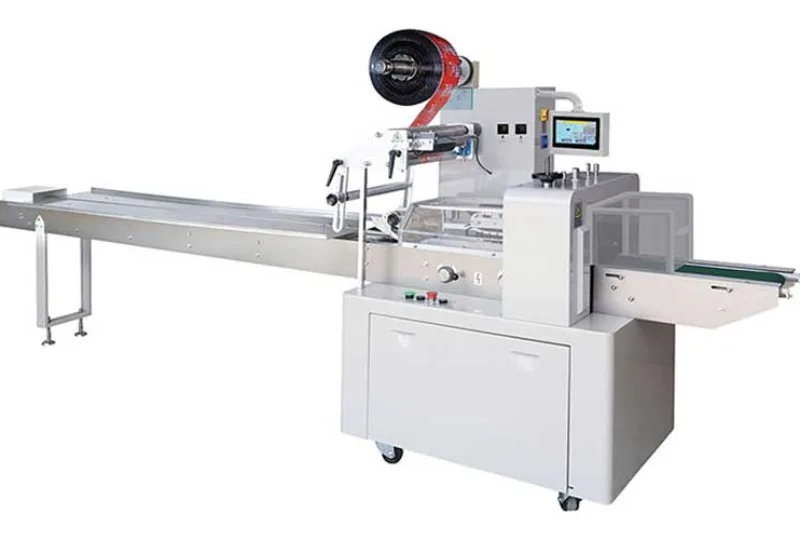
The packaging phase can be completed via two distinct mechanical setups: a horizontal flow wrap module or a pre-formed bagging module. The flow wrap system creates a pillow pack around the sliced loaf from a single film roll, supporting film widths up to 800 mm. For bakeries using pre-formed wicket bags, the bagging and sealing module operates using PE films. This system occupies a footprint of 4,625 mm in length and 1,800 mm in width. It automates the bag-opening process via pneumatic actuators, inserts the sliced loaf, and seals the package using a clip band or twist tie mechanism.
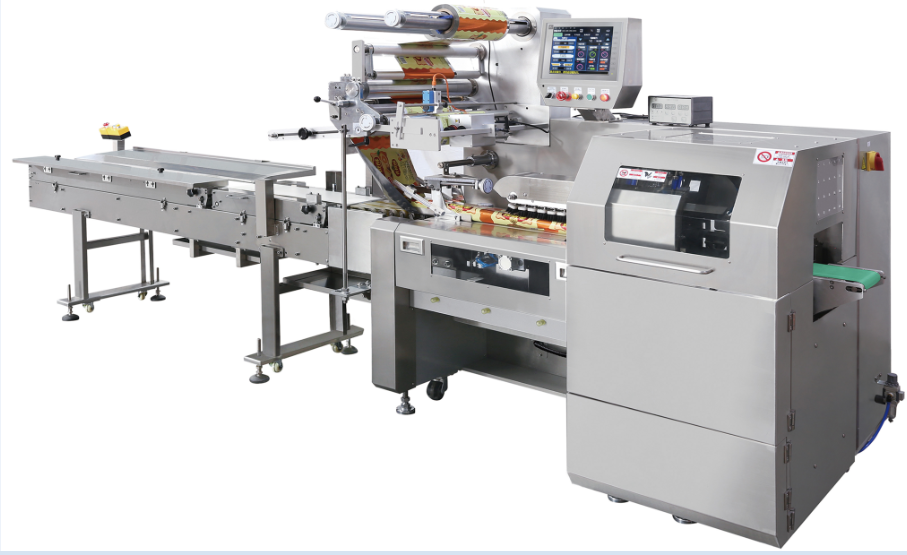
For high-capacity facilities, advanced systems integrate both slicing and bagging into a single cohesive unit, saving floor space and eliminating transfer conveyors. All systems must comply with strict hygiene standards, utilizing AISI 304 food-grade stainless steel frames, removable crumb trays, and IP-rated motors to simplify washdown processes. These safety and operational standards are verified by international certifications, including CE marking for flow packaging machines and automatic packaging systems.
Data/Solution Comparison
The following table outlines the technical differences, capacity variations, and estimated physical footprints of the three primary tiers of bread packaging systems.
| System Tier | Estimated Footprint (L × W) | Packaging Speed | Automation Level | Typical Capacity |
|---|---|---|---|---|
| Entry-Level | 4.6 m × 1.8 m | 25–40 bags/min | Semi-automatic / basic PLC | 1,000 loaves/hour |
| Mid-Range | 5.5 m × 2.1 m | 50–65 bags/min | Recipe-driven, servo control | 2,500–3,000 loaves/hour |
| High-Volume Industrial | 8.5 m × 2.5 m (includes cooling/decrusting) | 75+ bags/min | Fully integrated, remote diagnostics | 4,500 loaves/hour |
Frequently Asked Questions (FAQ)
What is the minimum ceiling height required for a toas bread packaging line?
Standard packaging modules and slicers have a machine height ranging from 1,800 mm to 2,000 mm. A minimum ceiling clearance of 2.6 meters is recommended to allow for safe maintenance, blade replacements, and film roll loading.
Can a single line handle both flow-pack wrapping and pre-formed wicket bagging?
Standard machines are designed for one specific packaging style. Flow wrap machines pack products using continuous film rolls, whereas bagging modules utilize pre-formed wicket bags. Multi-packaging setups require separate machinery integrated via diverting conveyors.
What are the power requirements for a small-scale packaging line?
A typical compact slicer-bagger line operates on a three-phase 380V–400V electrical supply at 50Hz or 60Hz. The total power draw ranges from approximately 9.0 kW to 13.5 kW depending on the specific conveyor integrations.
Final Conclusion & Recommendations
Selecting the correct machinery configuration prevents operational bottlenecks and avoids wasting valuable floor space. Small bakeries with limited square footage should prioritize integrated slicer-bagger combination units to keep the total system footprint below 10 square meters. For businesses looking to invest in new production equipment, selecting systems with CE certification ensures long-term safety compliance and mechanical reliability. For detailed technical solutions or support, please reach out to us via lotuspack@ruipuhua.com.
About Us
Foshan Ruipuhua Machinery Equipment Co. Ltd is a Chinese manufacturer of intelligent packaging machinery founded in 2005. Operating from a 50,000 square meter factory in the Nanhai Economic Development Zone, Foshan, Guangdong, the company employs 300 staff members and delivers packaging solutions to more than 100 countries. Backed by over 20 years of R&D expertise, the organization designs synchronized packaging lines that integrate feeding, packaging, case packing, and robotics, holding CE certification for its flow packaging machinery and automated systems.

-
01
How do I choose the right speed for a toas bread packaging line to avoid crushing soft loaves?
22-06-2026 -
 02
02Packaging Machinery: Beyond Sealing, Driving an Efficient, Smart, and Sustainable Future
21-01-2026 -
 03
03Automatic Tray Loading and Packaging Equipment: Boost Efficiency to 160 Bags/Minute
21-11-2025 -
 04
04Automatic Soap Packaging Machine: Boost Productivity with 99% Qualification Rate
21-11-2025 -
 05
05A Deep Dive into Automatic Toast Processing and Packaging System
18-11-2025 -
06
The Future of Bakery Production: Automated Toast Processing and Packaging System
18-11-2025 -
 07
07Reliable Food Packaging Solutions with China Bread, Candy, and Biscuit Machines
11-10-2025 -
 08
08High-Performance Automated Food Packaging Equipment for Modern Production
11-10-2025 -
09
Reliable Pillow Packing Machines for Efficient Packaging Operations
11-10-2025 -
 10
10Advanced Fully Automatic Packaging Solutions for Efficient Production
11-10-2025
