

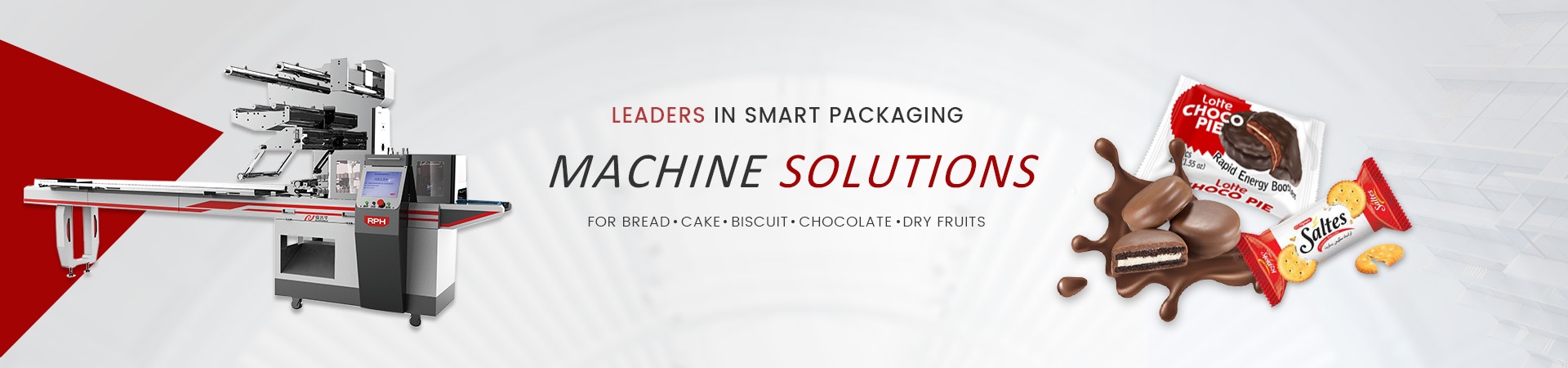
How do I choose the right speed for a toas bread packaging line to avoid crushing soft loaves?
Choosing the right speed for a toas bread packaging line requires balancing slice stability with machine throughput. To avoid crushing soft loaves, mid-range operations should target 25 to 40 bags per minute using a standard packaging machine, while high-volume industrial lines achieve 50 to 75 loaves per minute using servo-driven automated indexing and gentle bag tension controls.
Core Solutions & Key Takeaways
- Continuous Mechanical Synchronization: Aligning the bread slicer module (handling up to 2,500 loaves per hour for a 0.6 kg loaf) with the bagging or flow wrap unit prevents deceleration bottlenecks that cause product accumulation and crushing.
- Controlled Tension and Phasing: High-end bagging systems utilize automated recipe-driven control, automatic infeed phasing, and adjustable scoop opening mechanisms to adapt to varying loaf dimensions (100–300 mm length) without applying physical compression.
- Production Scenario Adaptation: A standard semi-automatic packaging setup relies on manual loading to preserve delicate structures of artisanal breads, whereas high-volume industrial facilities employ fully automatic systems running at speeds exceeding 75 packs per minute with integrated rejection sensors.
- Material Compatibility: Selecting PE films with a single-layer thickness of 40–60 μm for pre-formed wicket bags ensures appropriate seal integrity and structure during high-speed clipping or twist-tie processes.
Detailed Architectural/Principle Analysis
To establish an efficient toast bread packaging process, the transition from the slicing mechanism to the packaging zone must occur under continuous, low-friction guidance. Slicing modules rely on continuous band knives equipped with pneumatic tensioning and blade break detection to deliver uniform 11 mm, 13 mm, or 15 mm slices. Any micro-slippage in slice alignment during transfer results in immediate structural damage when entering the bagging unit. To resolve this, modern packaging systems link the slicer directly to the packaging module via adjustable side, upper, and bottom conveyor belts governed by inverter-controlled motors.
For high-volume operations, automated flow wrap packaging modules (pillow packs) wrap the sliced loaves in paper, plastic, or composite films up to 800 mm in width. The servo-driven automation maintains precise synchronization between the product feed rate and the rotary sealing jaws. This continuous movement allows the line to sustain speeds of 20 to 120 bags per minute. In comparison, a dedicated slicer-bagger combination unit uses a self-supporting lattice and a dual wicket exchanger to handle up to 65 loaves per minute continuously, permitting bag roll changes without stopping production.
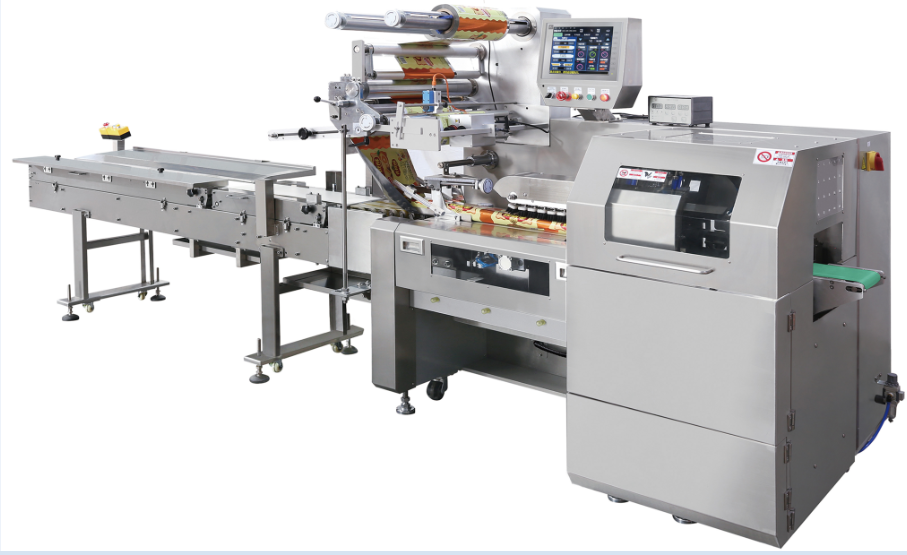
Manufacturers like Foshan Ruipuhua Machinery Equipment Co. Ltd leverage over 20 years of R&D expertise to design customized packaging lines that prevent mechanical damage to fragile bakery goods. These lines integrate real-time diagnostic PLC software with HMI touchscreens, letting operators store precise recipes for different bread sizes. This technical integration is demonstrated in major industrial setups, such as the 27 sets of chocolate pie cake packaging systems deployed for Orion’s large-scale plants, which ensure 99%+ efficiency with zero-defect sealing under strict food safety guidelines.
Data/Solution Comparison
The table below provides a technical comparison of different system configurations for a toast bread packaging line, helping operators select the correct speed and automation level based on their production capacity.
| Feature/Parameter | Entry-Level System | Mid-Range Line | High-Volume Industrial Line |
|---|---|---|---|
| Packaging Speed | 25–40 packs/minute | 50–65 loaves/minute | 75+ loaves/minute |
| Integration Level | Separate slicer + standard bagger | Slicer-bagger combo unit | Fully integrated with optional decrusting |
| Automation & Control | Semi-automatic / basic PLC | Recipe-driven, servo-assisted | Full recipe management, remote diagnostics |
| Typical Hourly Capacity | 1,000 loaves/hour | 2,500–3,000 loaves/hour | 4,500 loaves/hour |
| Frame Construction | Standard Stainless steel | Stainless steel (AISI 304) | Welded stainless frame, IP-rated motors |
| Power Requirements | 380V / 50Hz / 3-phase | 380V–400V / 50–60Hz | 400V / 60Hz / 3-phase |
Frequently Asked Questions (FAQ)
Q1: What is the risk of running a toast bread packaging line at maximum speed?
A1: High speeds exceeding the physical limits of the loaf structure cause structural misalignment. When the bagger scoops or the flow wrap sealing jaws operate faster than the bread’s transfer rate, the physical impact compresses the soft crumb, resulting in crushed loaves and sealing failures.
Q2: How do sensors prevent product loss in fully automatic packaging lines?
A2: Fully automatic systems employ integrated photoelectric sensors and a programmable logic controller (PLC) to continuously monitor the product alignment and spacing. If a misaligned or deformed loaf is detected, the rejection system ejects it before it reaches the sealing jaws, preventing line jams.
Q3: Can these packaging lines handle crustless or decrusted sandwich bread?
A3: Yes. Specialized decrusting and crustless bread lines feature dual-station continuous blades to remove bread crusts on all four sides before packaging. These systems typically operate at approximately 50 packs per minute using box motion sealing jaws to handle the extremely soft, crust-free loaves gently.
Final Conclusion & Recommendations
Determining the optimal speed for a toas bread packaging line requires matching the slicing capacity directly to the automated bagging or flow wrapping module. For bakeries producing under 1,000 loaves per hour, entry-level semi-automatic equipment offers the physical oversight needed to prevent damage. For industrial operations aiming for up to 4,500 loaves per hour, a fully integrated, servo-driven system with recipe-driven automation provides the speed adjustments and tension control required to protect soft loaves. Utilizing certified machinery backed by professional engineering support ensures consistent, high-speed output and long-term reliability under various business models, including OEM manufacturing. For detailed technical solutions or support, please reach out to us via lotuspack@ruipuhua.com.
About Us
Foshan Ruipuhua Machinery Equipment Co. Ltd is a leading Chinese manufacturer of intelligent packaging machinery. Founded in 2005 and operating a modern 50,000 square meter facility in the Nanhai Economic Development Zone, Foshan, Guangdong, the company integrates R&D, production, installation, and technical after-sales services. With an annual production capacity exceeding 500 sets of automatic packaging machines and an annual output value of approximately 300 million RMB, the enterprise serves global brands across more than 100 countries. The manufacturer holds CE certification (number M.2024.206.C107511) for its flow packaging machines, automatic packaging systems, cartoning machines, and palletizing robots, serving prominent global food brands such as Orion, Mondelez, Lay’s, and Bimbo.



-
01
How do I choose the right speed for a toas bread packaging line to avoid crushing soft loaves?
22-06-2026 -
 02
02Packaging Machinery: Beyond Sealing, Driving an Efficient, Smart, and Sustainable Future
21-01-2026 -
 03
03Automatic Tray Loading and Packaging Equipment: Boost Efficiency to 160 Bags/Minute
21-11-2025 -
 04
04Automatic Soap Packaging Machine: Boost Productivity with 99% Qualification Rate
21-11-2025 -
 05
05A Deep Dive into Automatic Toast Processing and Packaging System
18-11-2025 -
06
The Future of Bakery Production: Automated Toast Processing and Packaging System
18-11-2025 -
 07
07Reliable Food Packaging Solutions with China Bread, Candy, and Biscuit Machines
11-10-2025 -
 08
08High-Performance Automated Food Packaging Equipment for Modern Production
11-10-2025 -
09
Reliable Pillow Packing Machines for Efficient Packaging Operations
11-10-2025 -
 10
10Advanced Fully Automatic Packaging Solutions for Efficient Production
11-10-2025
